


After I learned last night that Das Racist has been broken up for over two months, my first reaction was to pick through their catalog for a certain lyric that might help illustrate what made them such an intensely beloved rap group amongst so many. I settled on something that Heems says at the end of "You Can Sell Anything," the Diplo-produced banger at the tail end of Sit Down, Man: "I'm intelligence in the age of the Internet where you're only as smart as how quickly you can use your smartphone." Doesn't exactly roll off the tongue, but then again, Das Racist came into into this world boxing kinda awkward.
For better or for worse, Das Racist became popular because of a novelty song. A funny one that was rooted in genuine social commentary, yes, but once people think of you as the stoned fast food rap dudes you're giving yourself something of an uphill climb in the rap game. Their debut mixtape Shut Up, Dude had its fair share of other novelty songs--"I Don't Owe Nobody Shit" is the project's sixth man, rhetorically speaking--but it was soon evident that the Brooklyn crew had more tricks up their sleeve than everybody assumed. They could rap! Well! Over nearly-forgotten Juelz Santana tracks! They, too, enjoyed smoking weed! They rapped over a Ghostface beat and didn't fuck it up too bad!
They were characters, too, which certainly helped once the media came calling. They were incredible interviewees, taking the conventional interview format and turned it into a bizarre bit of performance art, taking them on much in the same way that Captain Kirk handled the Kobayashi Maru scenario back in Starfleet Academy: In order to beat the game, you have to rewrite the rules. While Kirk did this by reprogramming some computer, Das Racist changed the rules by trolling the shit out of everyone, telling the New York Times to "Fall back," and deliberately misinterpreting the Village Voice's questions in the process calling the idea of interviews themselves into question. They beefed with Sasha Frere-Jones and won with an impressive degree of consensus. Simply put, they were an example of the new way that young people actually are--funny, goofy, concerned with issues on a structural level, elliptical, and punk as fuck in their own way. Intelligence in the age of the Internet at its finest.
Listening to the first two Das Racist projects, you tended to come away with very specific things--for many, they came across as funny, erudite and generally likable dudes, the type of Internet-addled knuckleheads you'd probably get along with if you ever met them in real life. Smarter listeners realized that the jokes came because they felt weird about their position in modern culture, a position largely tied to race and being both enlightened and disgusted by the mindfuck that is the subtle racism/classism/otherism you find in Liberal Arts academia. (Smarter listeners still realized that their hypeman Dapwell was actually the genius behind the whole operation, but Dapwell Appreciation Hour might be a whole different lamentation.)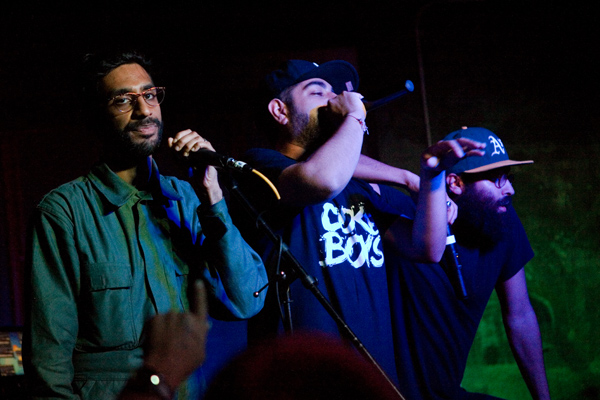 The thing about politicizing your art, even obliquely with lots of jokes and drug references thrown in, is that people, especially journalists, tend to seize upon that stuff at the sacrifice of everything else. And then, suddenly, your band is "about" something and you're in an equally frustrating box, that of the band that's always assumed to be pushing an agenda, or assumed to be making music in a very specific way, or people who you don't really give a shit about now like your music and expect something from you. But they weren't about anything; they were just three dudes discussing things that were relevant to their lives. Three dudes who, it should be noted, were very different people and rappers. Victor was probably a better rapper on a technical level, more concerned with making jokes about capitalism and questioning just what, exactly, was going on here. He was also the intense id of the group, fucking around the most and seemingly taking perverse pride in putting out dogshit-level mixtapes on purpose, only to later nick all his best verses from them. Heems, meanwhile, was the businessman, the guy who realized how they could actually make money off of all this if they played their cards right. Though both their verses were packed with meaning and homage, Heems was the one more often tackling the issue of race, foregrounding his South Asian heritage and using his verses as an opportunity to tackle social stratification and the terrible, stupid ways in which racism manifests itself in modern culture. He was also the guy who didn't mind getting TMI with you as he did on many of Das Racist's best songs such as "Amazing" and "Relax," the title track from the group's lone commercially-released LP. The pair had a unique chemistry that's rare and perhaps incapable of replication--many rap duos follow the "crazy dude/straight man" format, and both Heems and Kool A.D. were capable of being both within the span of a couple bars.
It cannot be stressed enough the degree to which DR became the unlikely saviors of New York hip-hop--as Dap said in an interview with SPIN, "When we started in 2009, 2010, there wasn't a New York rap scene." Through their music, Das Racist grabbed New York by the lapels and forced it to pay attention to what was going on in its own backyard. Through both Heems's Greedhead label as well as the general media attention and good will that they brought to New York, they helped give shine to guys like Le1f, Mr. Muthafuckin' eXquire and arguably even Action Bronson. They were a really weird shot in the arm when New York needed it the most.
Perhaps the most important thing about Das Racist is they understood the multiplicity endemic to human life and repped that as hard as Cam'ron repped the color purple or Young Jeezy repped the joys of cooking and distributing crack. It is possible, DR reminded us, to want to make the world a better place and also go out, get wasted, then try to get laid. It is possible, DR reminded us, to enjoy--and make--lots of different types of music and not have to explain yourself. It is possible, DR reminded us, to act really fucking stupid and have that serve as a display of profundity, or undermine your own display of overt intelligence because you also realize how asserting your intelligence upon people is annoying. But for whatever reason, some people didn't jibe with that for a really long time.
The bottom line, however, is that Das Racist might be over, but nobody died. Kool A.D. and Heems are both great MC's and don't seem to hate each other (I watched Heems freak out with enthusiasm last Sunday when Kool A.D. played Glasslands), and they'll each be doing solo stuff so it's not like they're done doing music. Their solo material will probably prove to be better than their work as Das Racist, because it'll be exactly what Kool A.D. and Heems want to do, rather than the result of compromises that undermine the creative vision of all involved parties. Dap is a genius, so I am 100% not worried about him. People move on and evolve, and things that seem like a great idea three years ago--like forming a band--don't always seem like great ideas in the present. And maybe, just maybe, Das Racist had run its course--ultimately, the group was an exercise in trying to make everyone understand what they were trying to accomplish. People get it now. So they're done.@drewmillard
The thing about politicizing your art, even obliquely with lots of jokes and drug references thrown in, is that people, especially journalists, tend to seize upon that stuff at the sacrifice of everything else. And then, suddenly, your band is "about" something and you're in an equally frustrating box, that of the band that's always assumed to be pushing an agenda, or assumed to be making music in a very specific way, or people who you don't really give a shit about now like your music and expect something from you. But they weren't about anything; they were just three dudes discussing things that were relevant to their lives. Three dudes who, it should be noted, were very different people and rappers. Victor was probably a better rapper on a technical level, more concerned with making jokes about capitalism and questioning just what, exactly, was going on here. He was also the intense id of the group, fucking around the most and seemingly taking perverse pride in putting out dogshit-level mixtapes on purpose, only to later nick all his best verses from them. Heems, meanwhile, was the businessman, the guy who realized how they could actually make money off of all this if they played their cards right. Though both their verses were packed with meaning and homage, Heems was the one more often tackling the issue of race, foregrounding his South Asian heritage and using his verses as an opportunity to tackle social stratification and the terrible, stupid ways in which racism manifests itself in modern culture. He was also the guy who didn't mind getting TMI with you as he did on many of Das Racist's best songs such as "Amazing" and "Relax," the title track from the group's lone commercially-released LP. The pair had a unique chemistry that's rare and perhaps incapable of replication--many rap duos follow the "crazy dude/straight man" format, and both Heems and Kool A.D. were capable of being both within the span of a couple bars.
It cannot be stressed enough the degree to which DR became the unlikely saviors of New York hip-hop--as Dap said in an interview with SPIN, "When we started in 2009, 2010, there wasn't a New York rap scene." Through their music, Das Racist grabbed New York by the lapels and forced it to pay attention to what was going on in its own backyard. Through both Heems's Greedhead label as well as the general media attention and good will that they brought to New York, they helped give shine to guys like Le1f, Mr. Muthafuckin' eXquire and arguably even Action Bronson. They were a really weird shot in the arm when New York needed it the most.
Perhaps the most important thing about Das Racist is they understood the multiplicity endemic to human life and repped that as hard as Cam'ron repped the color purple or Young Jeezy repped the joys of cooking and distributing crack. It is possible, DR reminded us, to want to make the world a better place and also go out, get wasted, then try to get laid. It is possible, DR reminded us, to enjoy--and make--lots of different types of music and not have to explain yourself. It is possible, DR reminded us, to act really fucking stupid and have that serve as a display of profundity, or undermine your own display of overt intelligence because you also realize how asserting your intelligence upon people is annoying. But for whatever reason, some people didn't jibe with that for a really long time.
The bottom line, however, is that Das Racist might be over, but nobody died. Kool A.D. and Heems are both great MC's and don't seem to hate each other (I watched Heems freak out with enthusiasm last Sunday when Kool A.D. played Glasslands), and they'll each be doing solo stuff so it's not like they're done doing music. Their solo material will probably prove to be better than their work as Das Racist, because it'll be exactly what Kool A.D. and Heems want to do, rather than the result of compromises that undermine the creative vision of all involved parties. Dap is a genius, so I am 100% not worried about him. People move on and evolve, and things that seem like a great idea three years ago--like forming a band--don't always seem like great ideas in the present. And maybe, just maybe, Das Racist had run its course--ultimately, the group was an exercise in trying to make everyone understand what they were trying to accomplish. People get it now. So they're done.@drewmillard
Advertisement